Are all cryptocurrencies mined
Interestingly, not all investors experience the same outcomes. A recent study revealed that 57% of cryptocurrency investors made money in the past year, while 16% broke even, and 14% reported losses https://drying-machine.org/. These statistics highlight how demand and trading activity directly influence price dynamics in the cryptocurrency market.
Competition among cryptocurrencies drives innovation, reshaping the market landscape. Ethereum’s layer-2 scaling solutions have boosted transaction volumes, while tokenization of traditional assets has opened new markets. These advancements attract institutional investors, increasing liquidity and driving price growth.
Demand is another critical factor in cryptocurrency price movements. When more people want to buy a cryptocurrency, its price goes up. Conversely, when demand decreases, prices fall. Trading volume often reflects this dynamic. For example, the global cryptocurrency market saw trading volumes peak at $3 trillion in November 2021, showcasing how investor activity can drive price changes.
The speculative nature of the cryptocurrency markets is another reason for the simultaneous movement of cryptocurrencies. Investors often speculate on the future value of cryptocurrencies based on current market trends and economic indicators. This speculation can amplify correlations, especially during risk-off events when investors tend to sell off risky assets, including cryptocurrencies. As a result, most cryptocurrencies tend to move together in the market.

Do all cryptocurrencies use blockchain
It can be a long, complex and costly chain of connections, with each taking a small fee from every transaction. Typically, it involves a series of banks or other large payment processing businesses who keep track of the money on its journey from A to B. Identities are verified, creditworthiness is established and sums of money are accurately reconciled between accounts.
The nonce value is a field in the block header that is changeable, and its value incrementally increases with every mining attempt. If the resulting hash isn’t equal to or less than the target hash, a value of one is added to the nonce, a new hash is generated, and so on. The nonce rolls over about every 4.5 billion attempts (which takes less than one second) and uses another value called the extra nonce as an additional counter. This continues until a miner generates a valid hash, winning the race and receiving the reward.
Ah, the age-old mix-up: crypto vs blockchain. It’s like confusing the engine for the entire car. Crypto, short for cryptocurrency, is a digital asset you can trade or invest in. Think of it as the fuel that powers various blockchain networks. On the flip side, blockchain is the underlying tech that makes this all possible. It’s the engine, the chassis, and the wheels rolled into one.
If you have ever spent time in your local Recorder’s Office, you will know that recording property rights is both burdensome and inefficient. Today, a physical deed must be delivered to a government employee at the local recording office, where it is manually entered into the county’s central database and public index. In the case of a property dispute, claims to the property must be reconciled with the public index.
A blockchain is a distributed database or ledger shared across a computer network’s nodes. They are best known for their crucial role in cryptocurrency systems, maintaining a secure and decentralized record of transactions, but they are not limited to cryptocurrency uses. Blockchains can be used to make data in any industry immutable—meaning it cannot be altered.
Cryptocurrencies all
The very first cryptocurrency was Bitcoin. Since it is open source, it is possible for other people to use the majority of the code, make a few changes and then launch their own separate currency. Many people have done exactly this. Some of these coins are very similar to Bitcoin, with just one or two amended features (such as Litecoin), while others are very different, with varying models of security, issuance and governance. However, they all share the same moniker — every coin issued after Bitcoin is considered to be an altcoin.
These crypto coins have their own blockchains which use proof of work mining or proof of stake in some form. They are listed with the largest coin by market capitalization first and then in descending order. To reorder the list, just click on one of the column headers, for example, 7d, and the list will be reordered to show the highest or lowest coins first.
Related Links Are you ready to learn more? Visit our glossary and crypto learning center. Are you interested in the scope of crypto assets? Investigate our list of cryptocurrency categories. Are you interested in knowing which the hottest dex pairs are currently?
At the time of writing, we estimate that there are more than 2 million pairs being traded, made up of coins, tokens and projects in the global coin market. As mentioned above, we have a due diligence process that we apply to new coins before they are listed. This process controls how many of the cryptocurrencies from the global market are represented on our site.
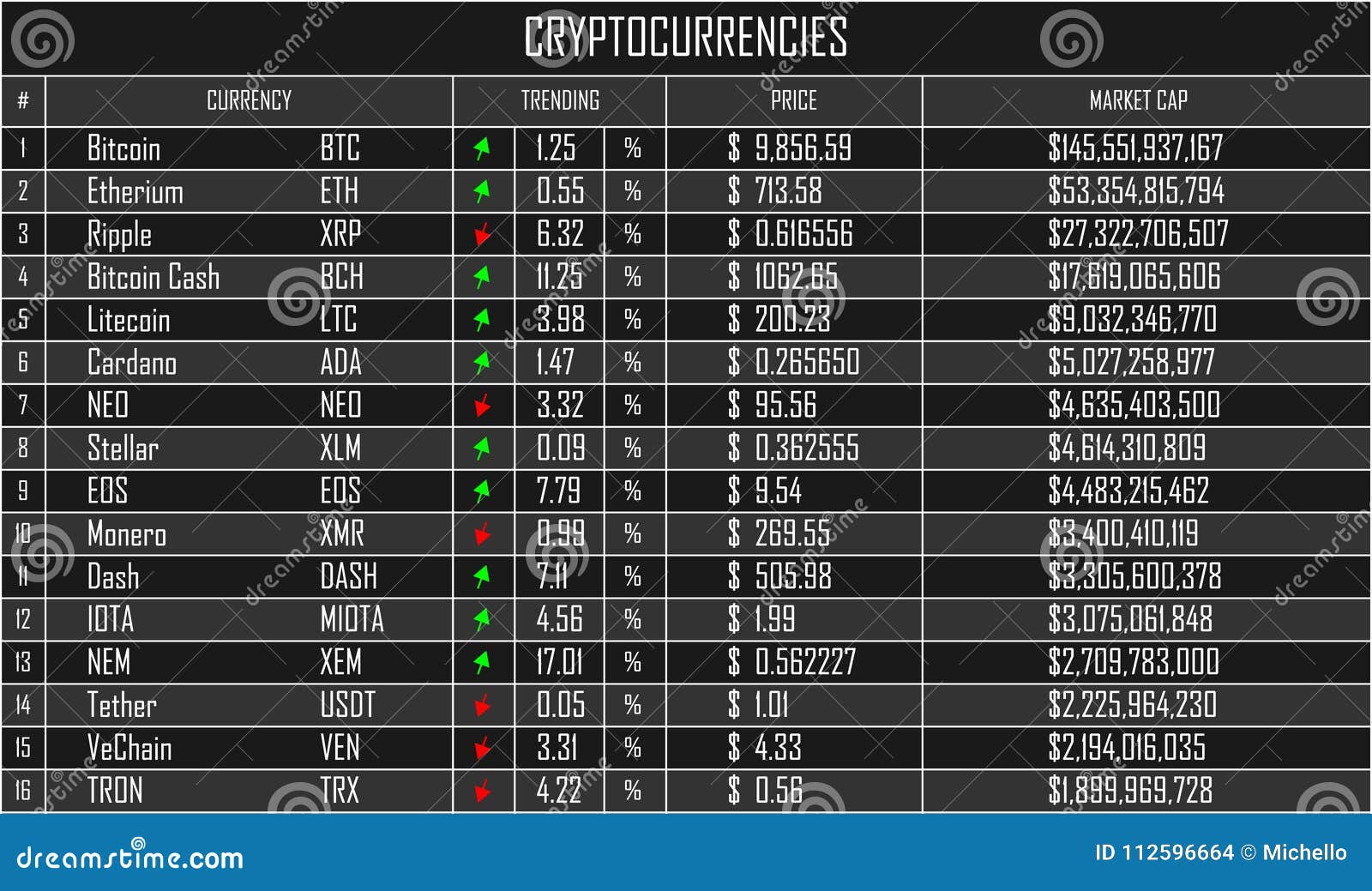
The very first cryptocurrency was Bitcoin. Since it is open source, it is possible for other people to use the majority of the code, make a few changes and then launch their own separate currency. Many people have done exactly this. Some of these coins are very similar to Bitcoin, with just one or two amended features (such as Litecoin), while others are very different, with varying models of security, issuance and governance. However, they all share the same moniker — every coin issued after Bitcoin is considered to be an altcoin.
These crypto coins have their own blockchains which use proof of work mining or proof of stake in some form. They are listed with the largest coin by market capitalization first and then in descending order. To reorder the list, just click on one of the column headers, for example, 7d, and the list will be reordered to show the highest or lowest coins first.
All the cryptocurrencies
Price volatility has long been one of the features of the cryptocurrency market. When asset prices move quickly in either direction and the market itself is relatively thin, it can sometimes be difficult to conduct transactions as might be needed. To overcome this problem, a new type of cryptocurrency tied in value to existing currencies — ranging from the U.S. dollar, other fiats or even other cryptocurrencies — arose. These new cryptocurrency are known as stablecoins, and they can be used for a multitude of purposes due to their stability.
Each of our coin data pages has a graph that shows both the current and historic price information for the coin or token. Normally, the graph starts at the launch of the asset, but it is possible to select specific to and from dates to customize the chart to your own needs. These charts and their information are free to visitors of our website. The most experienced and professional traders often choose to use the best crypto API on the market. Our API enables millions of calls to track current prices and to also investigate historic prices and is used by some of the largest crypto exchanges and financial institutions in the world. CoinMarketCap also provides data about the most successful traders for you to monitor. We also provide data about the latest trending cryptos and trending DEX pairs.
The UK’s Financial Conduct Authority estimated there were over 20,000 different cryptocurrencies by the start of 2023, although many of these were no longer traded and would never grow to a significant size.
To add a new coin to Blockspot.io, fill out our submission form with all the necessary details, such as name, ticker, logo, type, supply, and other metadata. The form can be accessed at Submitting a coin to our platform is completely free, and we’ll review your submission before adding it to our extensive database of cryptocurrencies.
The first chain to launch smart contracts was Ethereum. A smart contract enables multiple scripts to engage with each other using clearly defined rules, to execute on tasks which can become a coded form of a contract. They have revolutionized the digital asset space because they have enabled decentralized exchanges, decentralized finance, ICOs, IDOs and much more. A huge proportion of the value created and stored in cryptocurrency is enabled by smart contracts.